
Key Takeaways:
- The free-tier AI tools available in 2026 are genuinely capable — not watered-down demos — and a complete marketing stack covering content, design, email, scheduling, SEO, and CRM can be assembled at zero cost.
- Small business AI adoption has hit an inflection point, with usage jumping 41% in a single year and the gap between large and small businesses narrowing faster than any previous technology cycle.
- Most small businesses only need two core tools to cover the majority of their marketing needs — one for content creation and one for email — making the learning curve much more manageable than it appears.
- The ROI is concrete and well-documented: two-thirds of adopters save $500–$2,000 per month, the average marketer recovers 6+ hours per week, and payback typically arrives within 3–4 months.
- Premium-priced tools like Jasper and Copy.ai have largely been overtaken by free alternatives, meaning spending more does not reliably mean getting more.
- The biggest strategic mistake is over-investing in paid tools before building consistent habits — start free, find your friction points, then upgrade only where necessary.
- AI adoption is now a leading indicator of business health: 83% of growing small businesses use AI versus just 55% of declining ones, suggesting the window for gaining a competitive edge is narrowing.
Small business owners no longer need a marketing agency or a full-time content team to compete online. A carefully chosen set of free — or near-free — AI tools can handle everything from social media copy and graphic design to email sequences, SEO research, and customer chat. The data backs this up: Thryv’s 2025 survey of 540 small business decision-makers found that AI adoption among firms with 10–100 employees jumped from 47% to 68% in a single year, with content marketing emerging as the single most popular use case.
The barriers that once existed — cost, complexity, and the need for technical skill — have largely evaporated. The SBA’s longitudinal analysis shows that the AI adoption gap between large and small businesses has narrowed from 1.8× in early 2024 to just 1.2× by mid-2025, a compression that took decades with prior technologies like broadband internet. The tools driving that acceleration are mostly free.
Federal Reserve data from April 2026 shows that over 20% of U.S. firms plan to use AI in business functions in the first half of 2026, up from 9% at the start of 2025. The question is no longer whether to adopt, but which tools to prioritise. What follows is a category-by-category breakdown of the best free options available today, ranked by actual small business impact.
Why Free AI Tools Have Become Genuinely Powerful
Free tiers have changed materially in 2026. The underlying models powering no-cost plans — GPT-4o mini on ChatGPT, Gemini 1.5 Flash on Google’s suite, and Llama-based models on Meta AI — are capable of producing marketing copy that would have required a specialist copywriter two years ago. McKinsey’s State of AI research found that businesses utilizing AI marketing tools achieve a 20–30% boost in content production speed alongside a 10–15% decrease in marketing expenditures.
The model that defined AI tools — charge heavily for access — has been disrupted by competition. OpenAI, Google, Anthropic, and Meta are each racing to acquire users, which means meaningful capability is available at zero cost. For small businesses, this is a structural shift. According to Aibrify’s 2026 analysis of 15+ platforms, most small businesses need only two tools to cover the majority of their marketing needs: one for content creation and social scheduling, and one for email marketing.
The Best Free AI Tools by Marketing Category
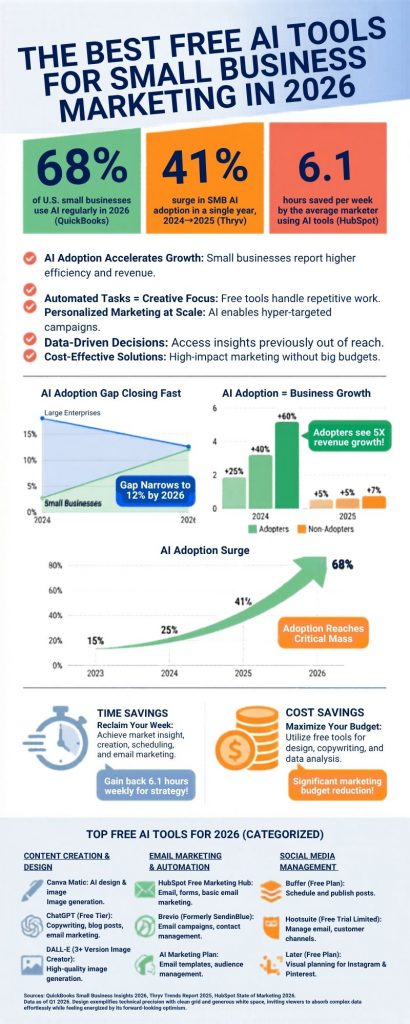
The following tools have been evaluated on three criteria used consistently across independent reviews in 2026: ease of use without technical expertise, genuine free-tier capability (not just a trial), and documented impact on marketing output or efficiency.
1. ChatGPT (OpenAI)
The most versatile free AI tool available. On the free tier, ChatGPT handles email copy, social media captions, blog post outlines, ad copy, customer service response templates, and product descriptions. It can write in different tones, adapt to brand voice with a clear system prompt, and iterate rapidly based on feedback. For any small business that needs written content across multiple formats, it remains the single highest-leverage free tool in 2026.
Best for: All written marketing contentFree limit: Unlimited GPT-4o mini; GPT-4o limited daily
2. Canva (Magic Studio)
Canva’s free plan includes access to over 250,000 design templates and a suite of AI features — Magic Write for captions, Magic Media for image generation, and Background Remover. Aibrify’s 2026 review describes Canva as “the undisputed king of DIY design,” noting that its AI features have matured significantly. For businesses doing any visual-first content — Instagram, Pinterest, email headers, or social ads — it is essentially non-negotiable. The limitation is that Canva is a design tool, not a marketing platform: scheduling and analytics require a separate solution.
Best for: Visual content, social media graphics, brand assetsFree limit: 250,000+ templates, limited AI credits/month
3. Mailchimp
Mailchimp’s free plan supports up to 500 contacts and 1,000 email sends per month — sufficient for most early-stage small businesses. Its AI features on the free tier include subject line recommendations and basic send-time optimisation. For a business building its first email list, Mailchimp provides a complete workflow from sign-up form to automated welcome sequence without a credit card. Once a list exceeds 500 contacts, paid plans become necessary, but the free entry point is genuine.
Best for: Email marketing, list building, automated sequencesFree limit: 500 contacts, 1,000 sends/month
4. HubSpot CRM
HubSpot’s free CRM tier offers contact management, deal tracking, and basic email tools at no cost — permanently, not just as a trial. For small businesses that need to track leads generated by their AI-powered marketing, HubSpot provides the connective tissue between marketing output and sales follow-through. Salesforce data shows 77% of SMBs say marketing and customer engagement are their top priority areas for AI, and a CRM makes that engagement trackable.
Best for: Lead tracking, customer management, basic emailFree limit: Unlimited contacts, limited features
5. Buffer
Buffer’s free plan covers three social media channels and allows up to 10 queued posts per channel at any time. For a small business maintaining a consistent presence on Facebook, Instagram, and LinkedIn, this is workable. The paid tier, at $6 per channel per month, is among the most affordable scheduling upgrades available. Buffer does not include AI content generation natively, making it best used in tandem with ChatGPT or Canva for the copy and creative.
Best for: Social media scheduling and queue managementFree limit: 3 channels, 10 queued posts each
6. Google Gemini + NotebookLM
For businesses already operating in Google Workspace — Gmail, Docs, Sheets, Drive — Gemini integration provides AI drafting and summarisation inside tools they already use daily. NotebookLM, Google’s AI research and synthesis tool, is free and particularly useful for turning competitor research, customer reviews, or market data into structured marketing insights. Google’s Grow with Google programme also offers free AI training workshops for small business owners, including live coaching in partnership with local chambers of commerce.
Best for: Research synthesis, Workspace-integrated draftingFree limit: Generous; Gemini Advanced via paid Google One
7. Semrush (Free tier)
Semrush’s free account provides keyword research, traffic analysis, and a position-tracking tool that monitors how search rankings change over time. For small businesses investing in content marketing, knowing which keywords to target before writing with ChatGPT or another tool transforms generic AI output into genuinely optimised content. Thryv’s assessment notes that Semrush is “a great resource for people new to SEO,” though the free account limits the number of results returned per tool.
Best for: SEO research, keyword discovery, competitor analysisFree limit: 10 searches/day across keyword and domain tools
The Recommended Free Stack for a Solo Operator
Based on the data and independent testing across multiple reviews, the optimal free AI marketing stack for a solo small business owner in 2026 involves four tools used in sequence:
| Stage | Tool | What it handles | Cost |
| Research & strategy | Google Gemini / NotebookLM | Market research, competitor analysis, content planning | Free |
| Content creation | ChatGPT | Copy for emails, ads, social posts, blog posts | Free |
| Visual design | Canva | Graphics, templates, image generation | Free |
| Distribution | Buffer + Mailchimp | Social scheduling + email sends | Free |
| CRM & tracking | HubSpot Free CRM | Lead management, campaign tracking | Free |
| SEO | Semrush (free tier) | Keyword targeting for all content | Free |
The total cost of this stack is zero. As the business scales, upgrading Canva to Pro (around $22/month) and adding a paid ChatGPT plan removes the only meaningful constraints. 20 Minute Marketing estimates that this minimal paid upgrade costs less than a single hour of a marketing agency’s time, yet produces a full month of marketing content.
What the Data Says About ROI

The business case for free AI marketing tools is no longer anecdotal. Multiple independent surveys now point to measurable returns across the same metrics.
Thryv’s 2025 survey found that 66% of AI-using small businesses save between $500 and $2,000 per month — savings that owners typically reinvest into marketing, technology, and infrastructure. Two-thirds of respondents said AI relieves pressure on themselves and their staff. A case study from one HVAC company with five employees showed marketing time drop from 15 hours per week to 3, lead volume rise 42%, and annual revenue grow by $120,000 — on a total AI tool spend of $1,800 per year.
Where Free Tools Still Fall Short
The honest caveat is that free AI tools have real limits. Canva’s free AI image generation credits are capped monthly. ChatGPT’s free tier throttles access to GPT-4o under heavy usage. Mailchimp’s 500-contact ceiling is crossed quickly by any business with an active lead generation effort. Buffer’s ten-post queue is manageable for one person but constraining for a business posting across multiple channels daily.
There are also capability gaps that free tools don’t address well. Advanced video generation, high-volume SEO content production, and sophisticated email segmentation all benefit materially from paid tools. Aibrify’s 2026 review recommends that most small businesses commit to two paid tools once revenue allows, noting that a single platform rarely covers both social and email well.
The strategic advice most consistent across independent reviews is to start with the free stack, build content habits around it, and upgrade only the specific tool where the free-tier ceiling becomes a daily friction point. Over-investing in paid tools before habits are formed is the most common mistake.
Tools That Overpromise: What to Avoid
Not every AI marketing tool earns its reputation. Jasper, which dominated 2023 and 2024 as the category leader in AI copywriting, has been largely overtaken by ChatGPT-4o at a lower price point, according to practitioners testing both. Copy.ai faces a similar assessment — no longer differentiated enough to justify its cost over the free ChatGPT alternative.
The same applies to all-in-one “AI marketing platforms” that bundle many features into a single subscription. Marketer Milk’s 2026 review makes the case that the right approach is a combination of focused free tools, rather than one expensive platform that handles everything adequately but nothing brilliantly.
The 2026 Opportunity Window
The data from the AdAI 2026 Small Business AI Statistics report contains a finding that should focus any small business owner’s attention: 83% of growing small businesses have adopted AI, compared to just 55% of declining businesses. AI adoption is not just a technology decision — it is becoming a reliable leading indicator of business trajectory.
BizBuySell’s 2026 Insight Report shows that AI adoption among small businesses hit 60% in Q1 2025 — a 127% increase from 2023 — and has continued growing at roughly 6% year-over-year into 2026. The businesses that built habits around these tools when they were new now operate with compounded efficiency. Starting in 2026 still provides meaningful gains, but waiting further compounds the disadvantage.
For a business spending 10–15 hours per week on marketing tasks that could be automated, the free stack described above offers a credible path to recovering most of those hours at no cost. The only irreplaceable input is the business owner’s knowledge of their own customers — which is exactly what AI tools cannot supply, and what makes the human-AI combination in marketing so durable.
Final Thoughts
Free AI tools are no longer a workaround — they’re a legitimate foundation for modern marketing. The advantage now goes to businesses that act early, build consistent workflows, and stay disciplined about when (and why) to upgrade.
You don’t need a complex stack or a big budget to compete. You need a simple system, used consistently. Start with the free tools, prove the process, and scale only where it actually makes a difference. The window is still open — but it’s not staying that way for long.